
Choosing the Right Rain Barrier for Your Property
In flood protection, a rain barrier is a physical system designed to block, contain or redirect rainwater and runoff before it reaches a vulnerable area.
It might be used across a doorway, driveway, alongside a building or around a larger area.
A few hours of intense rainfall can overwhelm drains, send water running down streets and leave low-lying areas with nowhere for the water to go. Once that water reaches a building, road, garage or other vulnerable area, things can get messy.
That’s where a rain barrier can help. Rather than trying to deal with floodwater after it has entered a property, a barrier can be positioned in advance to block, divert or contain incoming rainwater.
Depending on the system, it might protect a doorway, run along the side of a building or create a much longer defensive perimeter.
There isn’t one barrier that’s right for every situation. Protecting a garage entrance from surface runoff is very different from protecting a warehouse, road or critical infrastructure site from deeper water across a long perimeter.
The amount of water, area to protect, deployment speed, site conditions and whether the system needs to be temporary or semi-permanent all matter when choosing the right solution.
Rain Barrier vs. Flood Barrier vs. Water Barrier
The terms overlap but they’re not quite the same.
- A rain barrier is a broad descriptive term for a system used to manage water associated with heavy rainfall and stormwater runoff.
- A flood barrier is the more established term for a physical system designed to hold back, block or divert floodwater, whether that water comes from heavy rain, rivers, coastal flooding or storm surge.
- A water barrier is broader still and can describe systems used to control or contain water for a range of purposes, including flood protection.
So, in practice, someone searching for a “rain barrier for a garage” may actually be looking for a temporary flood barrier.
The terminology varies, but the underlying problem is often the same – keeping unwanted water out.
What Does “Rain Barrier” Mean in Building Construction?
In building construction, a rain barrier can refer to a Water Resistive Barrier (WRB) or rainscreen system installed behind exterior cladding.
These systems help manage moisture that penetrates the outer surface of a building, allowing water to drain away while protecting the wall assembly from moisture damage.
That’s a different application from the flood-protection systems we’re discussing here.
In this guide, rain barriers refers specifically to physical barriers used to protect homes, businesses, communities and infrastructure from rainwater, stormwater runoff and flooding.
How Do Rain Barriers Work?
Rain barriers operate on a fairly simple principle of keeping unwanted water from reaching the place you’re trying to protect. The way they do that depends on the type of barrier.
Blocking and Diverting Water
A barrier can be placed between incoming water and a vulnerable area such as a doorway, garage or building.
Depending on its design, it can:
- Block water and create a physical wall between the floodwater and the protected area.
- Divert runoff towards a safer drainage route.
- Contain water within a defined area to prevent it from spreading further.
The goal isn’t necessarily to stop every drop of water. It’s to control where the water goes before it becomes a bigger problem.
Using Water to Stop Water
Some flood barriers use the water itself to provide stability.
Water-filled barriers, for example, are initially lightweight and relatively easy to transport. Once deployed, they’re filled with water, adding considerable weight to the system.
As the water level increases, the barrier becomes heavier and can press more firmly against the ground, helping it resist movement from incoming water. It’s a simple idea but an effective one.
Creating a Protective Perimeter
Not every flooding problem starts at a doorway. Sometimes, water can approach from several directions, making it necessary to protect a larger area.
The barriers can be configured to protect:
- Individual entrances and doorways
- Garages and driveways
- The perimeter of a building
- Warehouses and commercial facilities
- Roads and bridges
- Larger infrastructure and public areas
The difference is mainly scale and configuration. A single doorway might need a short barrier specifically designed for an opening, while a flood-prone facility may require hundreds of metres of interconnected barriers to create a continuous protective perimeter.
Types of Rain Barriers for Flood Protection
Water-Activated Barriers
These barriers contain absorbent materials that swell when they come into contact with water, creating a raised barrier that helps slow or divert incoming water.
They’re often used around doorways, garages, driveways and other smaller vulnerable areas.
Water-Filled Barriers
Water-filled barriers are lightweight when transported and filled with water at the point of use. The added weight provides stability and helps the barrier resist incoming water.
They’re useful when you need to protect longer distances, buildings, roads or larger open areas. Many are also reusable, making them practical for locations that face repeated flooding.
Modular and Panel Flood Barriers
These systems use individual sections or panels that connect to create a barrier of the required length.
They can be configured for different sites and depending on the design, may use aluminum, plastic or other rigid materials.
They’re particularly useful for larger areas or locations where flood protection needs to be more substantial or semi-permanent.
Wall-Mounted and Permanent/Semi-Permanent Barriers
Sometimes the best barrier is one that’s already there when the rain starts.
Fixed systems can be installed around doorways, entrances, walls and other known flood points, providing protection without requiring a completely new setup for every storm.
They’re worth considering for areas that face recurring flood risk.
Sandbags and Sandbag Alternatives
Sandbags are still one of the most familiar forms of flood protection. Though they’re versatile, they are labour-intensive to fill, transport and position, particularly when a large perimeter needs protecting.
Modern alternatives include water-activated bags, water-filled barriers and modular flood systems. These can reduce some of the logistical work and in many cases, offer the advantage of being reusable.
Choosing the Right Rain Barrier for Your Situation
The best barrier isn’t necessarily the biggest or most heavy-duty option available. It depends on what you’re protecting, how much water you expect, the area that needs protection and how quickly you need to deploy the system.
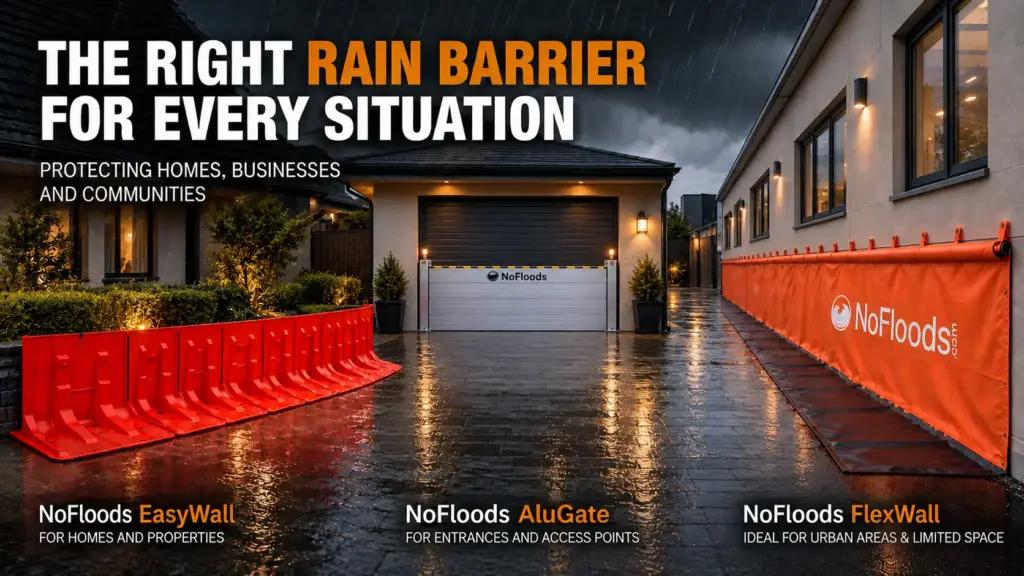
For Homes & Residential Properties
For homes, the main concern is often where water can get in i.e. garages, doors, driveways, garden gates and other low points around the property.
Recommended barriers include:
- NoFloods EasyWall: A quick-to-deploy and versatile option for protecting homes.
- NoFloods FlexWall: Useful where protection needs to be positioned along an existing wall or building.
- NoFloods FlexGuard: A practical choice when quick, tool-free deployment is important.
- NoFloods AluGate: Designed to protect vulnerable openings such as doors, windows, garages and gates.
For Commercial Buildings & Facilities
Commercial properties can have more entry points and larger areas to protect, from warehouses and loading areas to entrances and valuable equipment.
Depending on the site and its requirements, options include:
- NoFloods EasyWall: Flexible protection for buildings and surrounding areas.
- NoFloods FlexWall: Wall-mounted protection for vulnerable sections of a building.
- NoFloods FlexGuard: Useful when fast, tool-free deployment is required.
- NoFloods AluGate: Targeted protection for doors and other building openings.
- NoFloods AluBarrier: A modular solution for sites requiring more extensive, long-term protection.
For Communities & Urban Areas
Urban flooding can affect streets, public spaces, residential areas and community facilities, often requiring protection across multiple locations.
Recommended barriers include:
- NoFloods URBAN: Designed for short protection distances and urban applications.
- NoFloods EasyWall: A flexible option for buildings.
- NoFloods FlexWall: Useful where existing walls or structures can form part of the protection.
- NoFloods FlexGuard: Suitable where rapid tool-free deployment and ease of installation matter.
- NoFloods AluBarrier: Modular protection for larger or more demanding sites.
- NoFloods AluGate: Useful for protecting specific entrances and access points.
For Infrastructure & Large-Scale Protection
Roads, bridges, utilities, airports and critical infrastructure can require much longer protective lines and systems designed for demanding conditions.
Recommended barriers include:
- NoFloods PRO: A professional solution for large-scale flood protection.
- NoFloods AluBarrier: Modular aluminum protection for larger or more demanding sites.
- NoFloods AluGate: Targeted protection for critical openings and access points.
For Professional Flood Response & Construction
Emergency teams, municipalities and contractors often need systems that can be transported, deployed and reused as conditions change.
Recommended barriers include:
- NoFloods PRO: Designed for professional flood response and large-scale protection.
- NoFloods URBAN: A practical option for shorter-distance and urban deployments.
- NoFloods FlexGuard: Useful where fast, tool-free deployment is required.
- NoFloods SandGuard: A standalone solution for professional flood protection applications.
For Long-Term or Semi-Permanent Protection
If the same location faces recurring flooding, deploying a temporary barrier every time heavy rain is forecast may not be the most practical approach.
Here are some recommended barriers that can stay deployed or semi-deployed.
- NoFloods AluGate: Provides removable protection for known vulnerable openings.
- NoFloods FlexWall: Wall-mounted protection that can remain ready at locations with recurring flood risk.
What to Consider When Choosing a Rain Barrier
Choosing a barrier isn’t just about how high it can go. A system that works well for a garage may be completely unsuitable for protecting a road or large facility.
Before choosing one, consider the following:
- Expected Floodwater Depth
Start with the amount of water you may need to hold back. Shallow surface runoff requires a different approach from deeper, fast-moving floodwater.
Consider both the expected water level and the conditions that could cause it to rise further.
- Length of the Area to Protect
Measure the area rather than guessing. A doorway may need only a few metres of protection, while a building perimeter, road or community may require hundreds of metres.
- Deployment Speed
How quickly can you get the barrier into position?
For a site with little warning, tool-free or rapid-deployment systems can be particularly useful. Planned installations give you more flexibility to use systems that require additional setup or equipment.
- Temporary vs. Long-Term Protection
If flooding is occasional, a portable barrier that can be stored until needed may make more sense. For locations with a recurring flood risk, semi-permanent or removable protection can provide a more convenient solution.
- Storage, Transportation & Reusability
Think about what happens when the barrier isn’t being used.
- How much storage space does it require?
- Can it be transported easily to another location?
- Can it be deployed and reused multiple times?
These practical details can matter just as much as the barrier’s water-holding capability.
- Ground and Site Conditions
Finally, look at the site itself. Consider the surface, terrain, drainage, access points and any obstacles that could affect deployment or sealing.
A barrier needs to work with the site you have, not the ideal site you wish you had.
Important: Though these barriers can be highly effective, they shouldn’t be treated as a complete flood-management plan. In many situations, the best protection comes from combining several measures such as drainage and emergency planning.
Protect Your Property With the Right Rain Barrier
Heavy rain can turn into a serious flood risk faster than many people realize. The right barrier can give you an extra line of protection, helping block or divert water before it reaches the areas that matter most.
But there isn’t a one-size-fits-all solution. A homeowner protecting a garage has different requirements from a municipality protecting a road or a business safeguarding a large facility.
That’s why NoFloods offers a range of flood barrier systems for residential, commercial, urban, infrastructure and professional applications; from compact solutions for specific openings to systems designed to protect much larger areas.
Not sure which rain barrier is right for you? Contact us to discuss your flood protection needs. Our team will help you find the most suitable solution.
Frequently Asked Questions About Rain Barriers
Do they stop flooding?
They can help prevent floodwater from reaching a protected area but they don’t eliminate the risk of flooding. Their effectiveness depends on factors such as the barrier’s height and design, the depth and speed of incoming water, the length of protection required and the conditions at the site.
What is the best barrier for heavy rain?
The best choice depends on how much water you expect and the area that needs protection. A short barrier may be suitable for a building’s entrance, while a property or infrastructure site may require a longer, interconnected system.
Can they replace sandbags?
In many situations, yes. Modern flood barriers can provide a reusable alternative to sandbags and may reduce the labour involved in filling, transporting and placing individual bags.
How high can they protect against flooding?
There isn’t a single height that applies to every barrier. Different systems are designed for different levels of water protection.
Are they reusable?
Many modern flood barriers are designed for repeated use, although this depends on the specific system.
Reusable barriers can be particularly useful for properties that face recurring seasonal flooding or need to maintain flood protection equipment year-round.
How quickly can a rain barrier be deployed?
Deployment times vary considerably between systems. Some smaller barriers can be positioned very quickly, while larger systems require more preparation and potentially multiple people.
Tool-free and pre-engineered systems can be particularly useful when heavy rain is approaching and there isn’t much time to prepare.